
Year Established: 1970
ISO 9001:2015 Quality System
ISO 9001:2015 Quality System
Home > Blog > Evaluating Protective Zinc Finishes: Why Mechanical Galvanizing Outperforms Hot-Dip on Small Components
If you have ever opened a crate of galvanized bolts and found that nuts will not spin on, you know the headache of hot-dip galvanizing. While molten zinc protects massive bridge beams, liquid surface tension clogs threads and fuses small hardware under 18 inches.
At Mechanical Galvanizing, our Trenton, New Jersey facility has proudly provided Mechanical Galvanizing Services to manufacturers since 1970. Here is why cold mechanical plating eliminates thread seizing, protects high-strength steel, and outperforms hot-dip on small components.
Hot-dip galvanizing lowers steel into molten zinc at 840°F (449°C). Surface tension stops liquid zinc from draining cleanly from small holes, corners, and thread roots.
When small bolts leave the bath, extra metal settles in thread roots. As it cools, this zinc hardens into uneven lumps that stop a nut from spinning on by hand.
Operators spin small parts in a centrifuge basket to clear excess zinc, creating three clear problems:
Mechanical galvanizing is an ambient process. It uses no electric currents and no molten kettles, relying on kinetic energy inside a rotating barrel to cold-weld zinc powder directly onto steel.
The plating happens inside a tumbling barrel loaded with cleaned steel parts, water, promoter, glass beads, and pure zinc powder. Tumbling glass beads act like tiny hammers, peening and cold-welding soft zinc particles onto the steel layer by layer.
Parts emerge with a smooth, satiny silver finish. For more details, explore our guide on 10 Reasons Mechanical Galvanizing Outperforms Other Coatings.
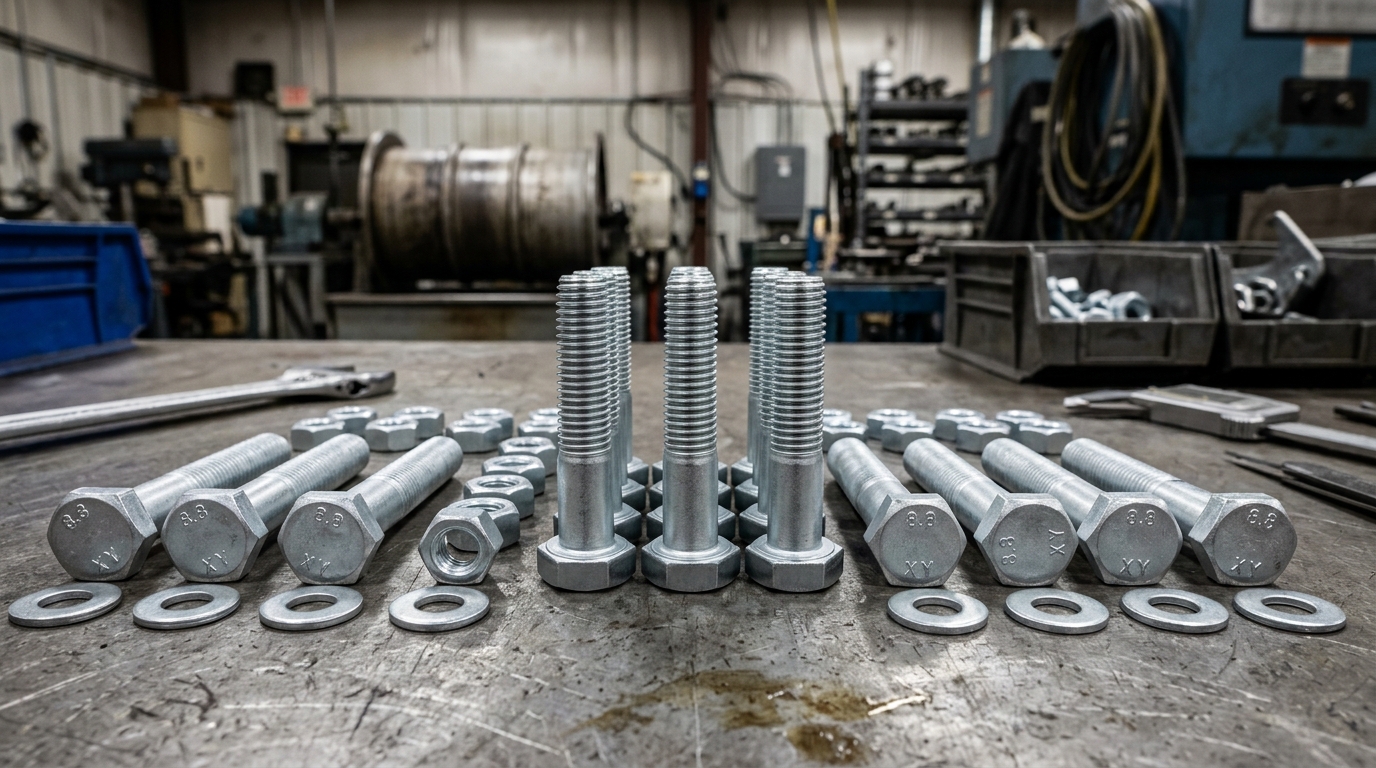
The biggest benefit for fastener buyers is thread precision. Your hardware threads together smoothly right out of the box.
Standard 60-degree screw threads follow a basic geometric rule: every 1 mil (25 microns) of coating on a thread flank increases bolt pitch diameter by 4 times that thickness.
Hot-dip leaves an uneven coating averaging 2 to 3 mils (50 to 75 microns), expanding pitch diameter by 8 to 12 mils so standard nuts cannot fit.
Suppliers tap nuts oversize or chase threads with taps after dipping to force a fit:
Mechanical galvanizing removes this headache. Because zinc deposits evenly without pooling, parts stay within standard Class 2A and 2B tolerances without re-tapping.
Process heat and chemistry are critical when coating Grade 8, ASTM A490, or Class 10.9 bolts.
High-strength bolts get toughness from heat treatment between 800°F and 900°F. Dipping hardened steel into an 840°F molten kettle reheats the metal, softening the core and lowering tensile strength below rated limits.
Mechanical galvanizing runs cold at room temperature (65°F to 80°F). It never detempers hardened fasteners, spring clips, or stampings.
Acid pickling and electroplating push atomic hydrogen into the steel lattice, causing high-strength bolts to snap under load without warning.
Mechanical galvanizing uses non-electrolytic cleaning and mild promoter chemistry, preventing hydrogen absorption completely. That is why engineering teams looking to prevent failures linked to hydrogen embrittlement in Texas industrial and energy projects trust cold mechanical barrel plating.
Our Trenton plant also provides related finishes, including mechanical cadmium for industrial machinery, mechanical tin for electrical distribution components, and mechanical cadmium for offshore equipment for facilities in Memphis and across Tennessee, Chicago and Texas. You can view all these options on our Industrial Metal Finishing Services page.
For small hardware, comparing both finishes side by side shows where each process fits:
| Feature | Hot-Dip Galvanizing (ASTM A153) | Mechanical Galvanizing (ASTM B695) | Practical Impact |
|---|---|---|---|
| Process Heat | 830°F–850°F (Molten bath) | 65°F–80°F (Ambient temp) | Protects steel hardness |
| Thread Fit | Uneven; fills thread roots | Smooth and uniform overall | No nut re-tapping needed |
| Hydrogen Risk | Possible from acid pickling | None (Non-electrolytic) | Safe for Grade 8 / 10.9 bolts |
| Parts Sticking | Common on flat washers | Zero sticking (Beads separate parts) | Eliminates scrap clumps |
| Surface Look | Rough, prone to dross | Smooth, satiny silver finish | Cleaner fit and consistent torque |
| Best Part Size | Large beams and heavy plates | Hardware under 18 inches | Lowest installed assembly cost |
Specifying mechanical galvanizing on drawings and purchase orders is straightforward. Reference ASTM B695 and select the thickness class for your environment:
Selecting the right coating is only half the battle; your finishing partner must deliver tight consistency batch after batch.
At Mechanical Galvanizing, our Trenton, New Jersey plant is ISO 9001:2015 certified. We run barrel lines built for steel parts up to 18 inches long and 3 pounds in weight. Whether you need barrel-plated fasteners in NJ or high-volume runs of threaded studs in NJ, we ensure uniform zinc protection that fits your assemblies straight out of the box.
For shops outside the Northeast, we handle daily freight shipments from the Midwest, South, and beyond.
If you want to eliminate thread galling, prevent brittle failures, and cut assembly scrap, Contact Our Facility or call us at (609) 393-4833 to review your drawings and request a quote.
Does mechanical galvanizing protect against rust as well as hot-dip galvanizing?
Yes. At identical coating thickness, mechanical galvanizing provides equal barrier and sacrificial protection. Specifying ASTM B695 Class 55 delivers over 1,000 hours of salt-spray resistance without red rust.
Why do mechanically galvanized nuts avoid oversize tapping?
Because mechanical zinc deposits evenly without pooling in thread roots, screw threads keep their original shape. Standard Class 2B nuts spin cleanly onto Class 2A bolts with complete zinc coverage preserved.
Is mechanical galvanizing safe for Grade 8 and Class 10.9 bolts?
Yes. Mechanical galvanizing runs cold and uses no electric current. It does not introduce atomic hydrogen into the steel, making it safe for high-strength, heat-treated fasteners.
What is the maximum part size for mechanical galvanizing?
Our barrel lines handle parts measuring up to 18 inches in length and weighing up to 3 pounds. This includes bolts, threaded studs, washers, U-bolts, rail clips, and small stampings.
Can conversion coatings or lubricants be added over mechanical zinc?
Yes. Hardware routinely receives clear or yellow trivalent chromate sealers for extra corrosion defense, as well as wax lubricants like PS&T 902 for smooth torque during tightening.
How do companies outside New Jersey ship hardware to your facility?
Out-of-state manufacturers ship parts directly to our dock at 185 Oakland Street, Trenton, NJ 08618 using standard freight carriers. We process your lot and ship it back on schedule.

